
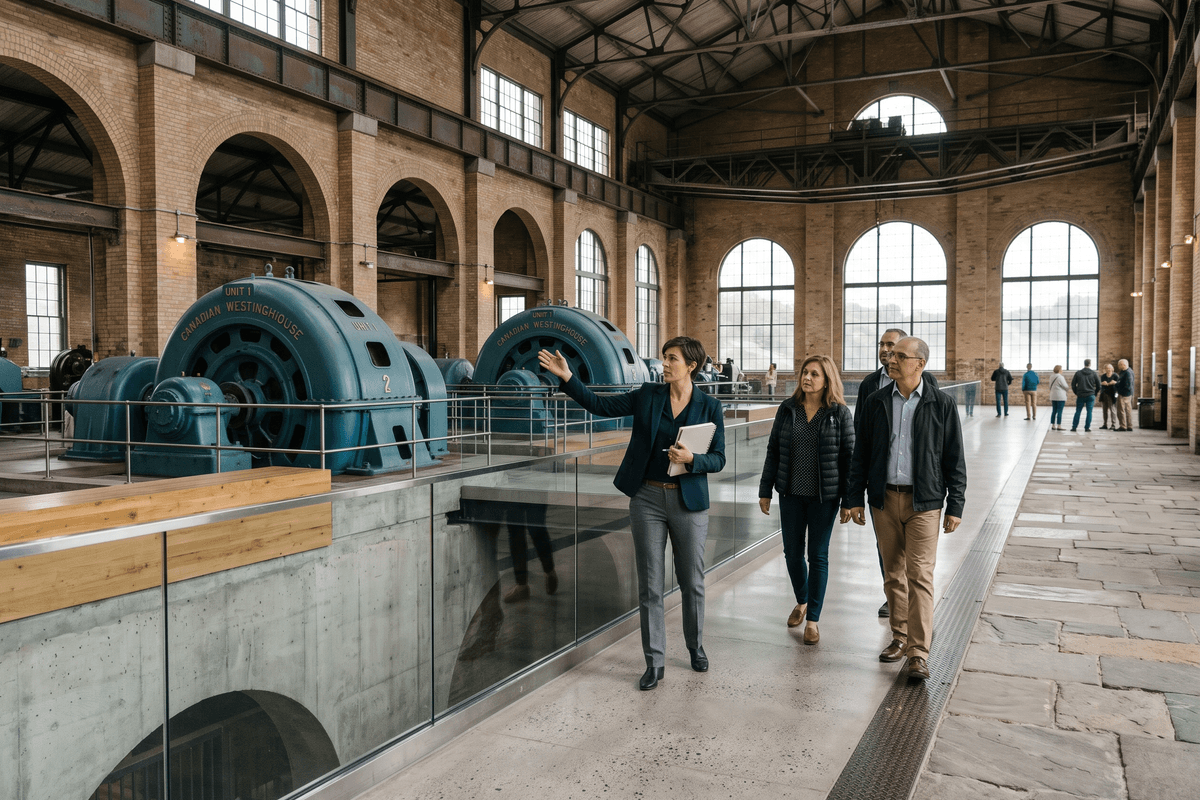

Construction has started on a $350-million redevelopment that will turn Niagara Falls’ Toronto Power Generating Station into a year-round hotel and visitor destination. Niagara Parks, Toronto Power Hotel Inc., and project partners marked the start of on-site work on November 12, and Niagara Parks says substantial completion is expected in 2029. The building is a designated National Historic Site, so the project sits at the intersection of heritage conservation, hospitality, and public access. For architects and heritage professionals, the notable feature is less the hotel program itself than the way the public has been written into the brief.
What is being built
The project will convert the building into what the developer describes as the region’s first five-star hotel. As the source puts it, “The project will convert the designated National Historic Site into the region’s first five-star hotel, while preserving the landmark building’s architectural and cultural heritage.”
The program is broad. According to the source, the redevelopment will include:
- Free indoor and outdoor public viewing areas
- Four to five restaurants
- A wellness and social spa
- Multiple event venues
- An art gallery and a museum
- Programming designed to attract visitors throughout the year
Niagara Parks expects the property to create up to 900 jobs in the region once it opens. The source does not name the architects or the design team for the conversion, so the design approach itself has not yet been publicly detailed in this announcement.
Who is delivering it
The development vehicle is Toronto Power Hotel Inc., a partnership between Society Developments and Pearle Hospitality. Pearle, which the source describes as an Ontario-based hospitality company known for destinations such as Elora Mill Hotel & Spa, will manage and operate the property once it opens. That split matters: the developers and the eventual operator are both on the hospitality side, and the project’s public-facing commitments will be carried out inside a commercial operating model.
The building itself has a long history. Designed by Canadian architect E.J. Lennox, the station began operating in 1906 and supplied power to the region until it was decommissioned in 1974. Canada designated it a National Historic Site in 1983. Niagara Parks launched a three-stage procurement process in fall 2021 to find a private-sector partner. The redevelopment reaching construction in late 2026 means that the procurement phase alone spanned several years before any work on site began.
Public access as a condition of the conversion
Most adaptive reuse projects in heritage buildings are justified by their commercial uses. Here, the free indoor and outdoor viewing areas, along with the art gallery and museum, are listed alongside the hotel and spa as core components. That tells us the owner has treated public access as part of the building’s purpose rather than a courtesy attached to a private amenity.
For practitioners, this is a useful pattern to note. When public access is written into a heritage project from the outset, it shapes circulation, sightlines, security, and how the building’s historic fabric is revealed. Viewing areas are not decorative; they determine where visitors can walk, what they can see of the original structure, and how the building meets the street and the falls. Designers working on similar projects should expect public-access requirements to be brought into the brief early, not negotiated late.
What to take from the procurement timeline
The three-stage procurement that began in fall 2021 is worth examining closely. It shows that a National Historic Site with a long period of vacancy and no operating use can require a multi-year process to find a partner who can carry the project financially and operationally. For consultants, this means that the design phase is likely to be informed by a partner selected through a competitive process, with the requirements of that process already defining the scope.
It also means that heritage professionals may be engaged at different points than in a conventional commission. In a procurement-led project, the heritage constraints and public commitments are often set before the designer is appointed. Designers who want influence should understand the owner’s procurement criteria and the public obligations they establish.
What to watch for next
Several questions will determine how this project is judged once it opens:
- Design team disclosure. The current announcement does not name the architects or heritage consultants. Their identities and approach to the historic fabric will be an important part of the story as the project moves forward.
- Delivery of public spaces. Whether the free viewing areas, gallery, and museum are delivered at the scale described will show how the public commitments hold up through construction and operation.
- Progress toward 2029. Substantial completion is expected in 2029, and the schedule will test the coordination between the heritage work, the hospitality fit-out, and the operator’s requirements.
- Operating model. Once Pearle Hospitality takes over management, the balance between public access and paid hospitality use will become visible in daily operations.
For Canadian architects, the Niagara project is a reminder that heritage conversions increasingly depend on how public access, commercial viability, and conservation are written into the procurement itself. The details of the design will matter, but the terms set at the start will shape what the public actually gets.